
austrians curious about sweden
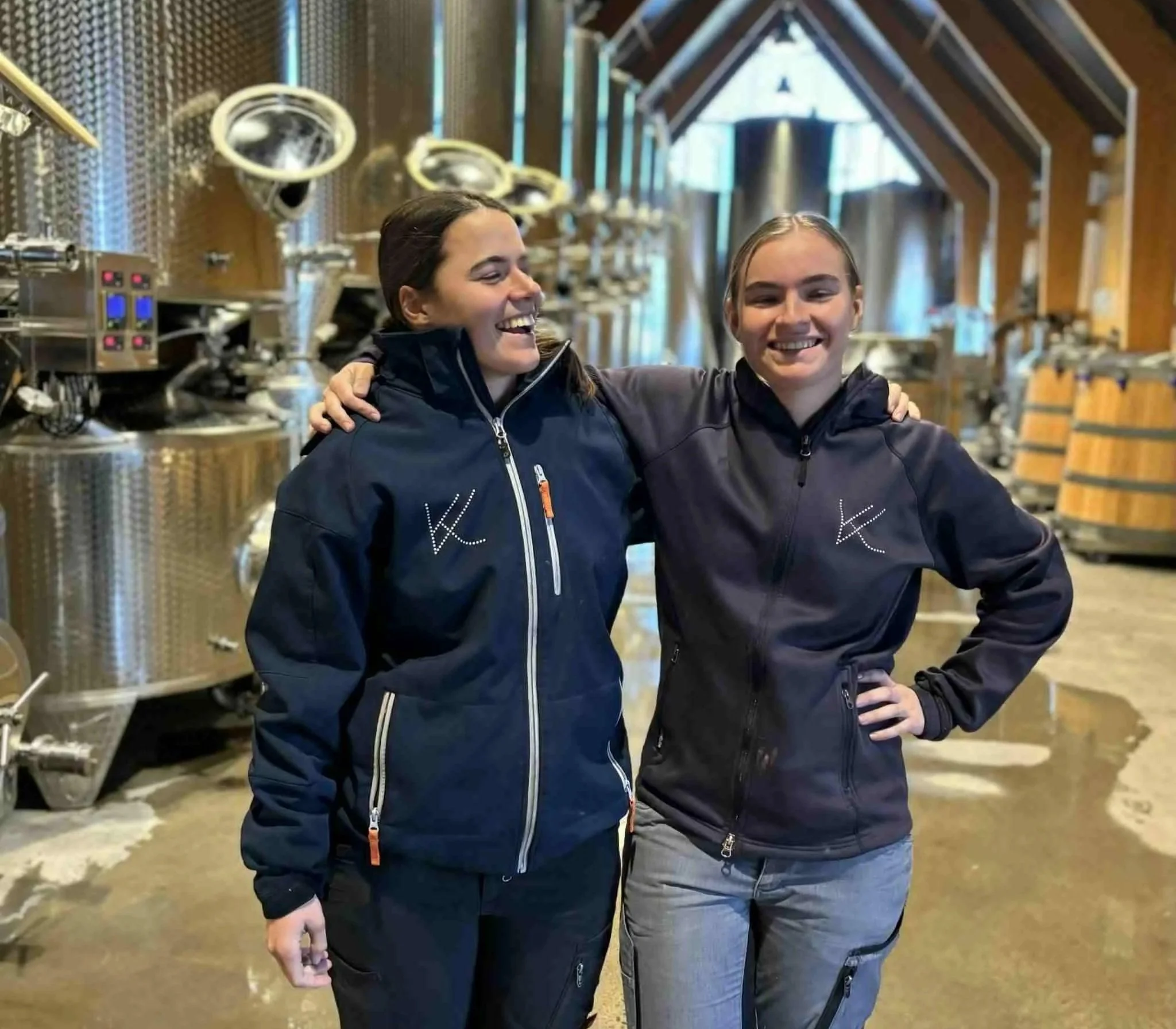
“In Austria, a lot revolves around inherited knowledge, something that is learned through generations. Here, you have to find a new way. A Swedish way.”
So say Cäcilia and Antonia Skoff from Austria, who are doing an internship at Kullabergs Vingård for six months.
At Kullabergs Vingård, English is the “official” language. There are always interns from different countries here. Sisters Cäcilia and Antonia Skoff come from Styria, one of the most famous wine regions in Austria. Both attended the Silberberg School of Viticulture; Antonia continued at Klosterneuburg, while Cäcilia chose to focus on tourism and is considering complementing her studies with sommelier training. They arrived at Kullaberg in mid-June 2025 and will stay until just before Christmas.
“I like Sweden and wanted to do my internship abroad. We chose Kullaberg because it is the best known estate,” says Cäcilia, pointing out the coincidence that much of the cellar equipment at Kullabergs Vingård is produced in their hometown of Gamlitz.
The sisters come from a family of winemakers. Their parents run the Die Amtmann farm, which also has a café, shop, garden, and organizes courses. This is one of the big differences between Sweden and Austria, as they see it. In Sweden, you have to learn winemaking from scratch. In Austria, you are often born into the profession.
“Sweden needs to find its own profile, and PIWI grapes and early-ripening varieties are one way to go,” says Cäcilia, explaining that abroad, no one yet thinks of Sweden as synonymous with Solaris, while many Swedes see this variety as their signature grape.
The sisters believe that it takes time to build up the kind of recognition that classic wine regions have.
"In both Styria and elsewhere in Europe, each region is known for its specific grapes and its type of wine. Sweden is still too young to have such an identity.”
But being a new wine country also has its advantages. You are free to experiment without being burdened by restrictive traditions – an advantage if you don't yet know what works best and where. Despite fundamentally different conditions, the sisters find it difficult to point to anything in particular that distinguishes Sweden and Austria in terms of wine production.
“Here, you have new grape varieties, but otherwise it's a lot of little things... that also differ at home. Some plow their soil, other winemakers don't. Some have taller trunks, others have shorter ones,” says Antonia.
In Sweden, PIWI grapes are grown almost exclusively, fungus-resistant varieties that can withstand the climate. But even in Austria, more and more people are starting to look at these grapes. Mainly because they can survive with less or no spraying.
“In Styria, it's too hot for Solaris, but we have Souvignier Gris, Muscaris, and Donauveltliner, among others,” says Antonia, continuing:
“At home, it's tricky to spray because it rains so much - in other words, perfect weather for mold and disease. It's especially challenging if you want to grow organically, so it's easier with PIWI grapes, which are tougher.”
They glance at the clock and out the window. The sky is November grey, but the work must be done. Out in the vineyard, the last weeds of the season need to be removed, and soon it will be time for pruning.
Before they finish their internship, they are expecting visits from curious relatives who have vineyards back home in Austria. Sweden may be a new wine country, but we have been growing PIWI longer than they have.
Text & photo: Lena Särnholm